
Unlocking growth - The ultimate 2026 marketing plan for therapists
The way people discover brands is evolving. What do recent marketing changes mean for businesses in the mental health and wellness space? Let’s talk…
© Rebekah Hudson - Author
1/1/20266 min read
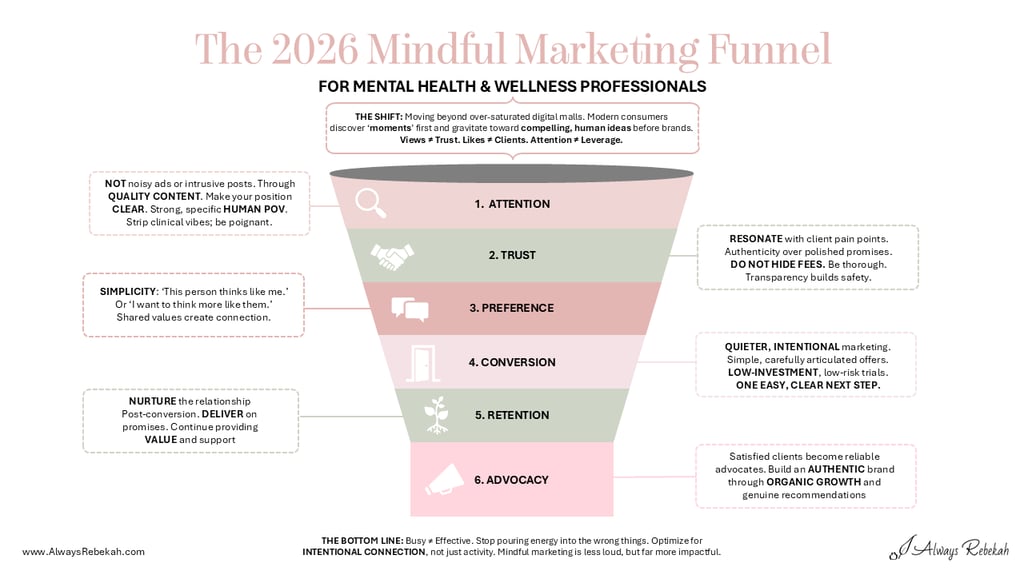
1. Get their attention.
But not through expensive ads or intrusive sponsored posts. Through quality content. Make your position clear. Your POV and brand voice need to be strong, and you need to be specific. Being friendly, general, and vague doesn’t convert. Strip your bio, about page, service description, blogs, and social media content of clinical vibes and get really human and really poignant.
If you utilize social media think short hot takes or organic content that strikes a very specific cord. You don’t need to provide answers. You need to resonate. Going viral once isn’t going to make your business thrive. You need to be consistently recognizable and authentically relatable.
2. Build trust.
Spill the tea. Don’t hide your fees. Spell out your service description. Don’t settle for vague verbiage about how you’ll 'custom curate a unique experience that’s specific to individual needs.' You can say that, but it’s not enough. Modern day consumers need more information before converting.
Clearly state the exact type of person you help and tell them precisely how you help them. Be up front and tell them what they can expect. Because if people trust you, they will listen, and if they’re listening, you don’t need to be flashy or loud.
^ Did you catch that? You don’t have to be trendy. Your ability to resonate with your clients' pain points will build trust. Not polished promises and fanciful branding.
This is good news. It means you don’t need to be everywhere, all the time, doing all the marketing things. You just need to be honest, clear, and thorough, and if you do so in a calm way, you’ll stand out. Today more than ever people are drawn to a peaceful marketing approach.
What builds trust?
Case studies
Examples
Blogs
Newsletters
Reviews
Compelling about page or bio*
Quality photos and videos and posts
Behind-the-scenes look
Guest podcast appearances
Crystal clear values
Useful opinions
Absolutely clarity around pricing and services
*Believe it or not, your about page is one of the most powerful places to score serious trust.
Learn more:
The biggest mistake therapists make with their bios and about page
ABOUT vs HOME page – Understanding the difference and why you need both
3. Become their preference.
Competition is fiercer than ever. In a world where AI is on the rise and there is an over-abundance of options, the honest reality is that people can like you and your brand and still choose someone else.
It all comes down to preference. Who does the prospective client prefer? And what is that preference based on? It’s really simple. Preference is formed when someone feels: “This person thinks like me.” Or, “This resonates. I want to think more like them." This is how smaller, less experienced, less flashy brands are scooping up market share. They build trust then capture preference – simply by resonating and being genuinely, authentically relatable.
Key takeaway:
If you’re impressive, people will be impressed. If you’re relatable, people will connect.
4. Earn the conversion.
The world has caught on. The most successful brands are opting for a quieter form of marketing that is less aggressive, but far more intentional.
What converts?
✔️Simple, carefully spelled out offers
✔️Low-investment, low-risk trials or soft offers
✔️One easy, clear next step
Many therapists think they don’t have to spell everything out on their website. I’ve talked with some who’ve literally said they don’t want to ‘put that on the website.’ They want to give ‘just enough to inspire folks to call them’ because they think they have a better chance of converting a potential client if they have them on the phone.
Nope. Not in this day and age. And definitely not if your Target Audience (TA) includes Gen X, Millennials, Gen Z, parents, or busy working professionals.
Key takeaway:
If someone needs to call you so you can explain your offer better, then your web content isn’t working. Your funnel is broken. And you will lose business to the service provider who was more thorough than you, even if they’re less experienced.
5. Retain them.
Let’s recap. At this point…
✔️ You’ve scored prospective client attention through quality, hyper-targeted content.
✔️ You’ve established trust through thoughtful, mindful transparency.
✔️ You’ve earned their preference by being consistent and relatable.
✔️ And they’ve finally converted, because you made it easy for them.
Now it’s time to retain them. If you have a client who comes to see you 1-3 times and then ghosts you, then THIS is where you need to focus your efforts.
Honestly, there’s so much to be said about how to improve your retention rates, that I wrote a separate blog for it. Check it out: 5 Ways to improve client retention
6. Advocacy and referrals
Paid ads stopped being a strong marketing tactic years ago – especially for therapists and individuals in the health and wellness space. The best marketing technique will always be word-of-mouth referrals (closely followed by SEO). The way your clients talk about you to their friends and family is ultimately what moves the needle on your business.
Whenever ethical and appropriate, share results, client recovery stories, and reviews. And don’t be afraid to put yourself out there. You can be calm, quiet, and peaceful… but not shy. Timidity will not help you grow your brand and become recognizable.
Pursue guest posting, answer questions online, seek out speaking engagements, and get involved in community recognition initiatives. Most importantly, network – not just with other industry professionals, but with the general population. Think book clubs, workshops, social gatherings, etc. Now more than ever, your ability to authentically connect in the real world will deliver greater ROI than your social media activity.
Key takeaway:
The real world > The reel world 😉
The bottom line
Busy does not always equal effective. If you feel like you’re pouring massive amounts of time and energy into your marketing, but you’re not seeing results… you’re probably optimizing or investing in the wrong thing.
I’m a full-time freelance writer and marketing consultant operating in the mental health and wellness space. I help therapists, private practices, and mindful organizations elevate their marketing and web-content to help them grow their brand and improve their business.
Want to connect?
To request a virtual consultation call, please contact me.
A 60-minute virtual consultation is $65. I’ll hop on a virtual meeting with you, and we’ll discuss your current marketing strategy – what’s working, what’s not, and where there’s opportunity for improvements.
All my best experience, expertise, and energy as a marketing professional will be yours for the entire hour. You can ask me whatever questions you want, and we can brainstorm potential solutions together. If improving your web content is something you’re interested in, we’ll discuss your goals, and I’ll provide you with a custom project quote following our consultation.
Not ready for that? No problem…
You can download my Mindful Marketing Guidebook for free simply by subscribing to my newsletter. The guidebook is a step-by-step marketing plan designed to help therapists and soul-preneurs in the health and wellness space grow their brand with peaceful, authentic confidence. It’s full of helpful how-to’s and a complete checklist to help you elevate your marketing and connect with your ideal client.
Subscribe here and the guidebook will be sent directly to your inbox.
Technology and modern-day realities are changing consumer behavior. Have you felt the shift?
The way people interact, engage, and convert with businesses is evolving, and that means marketing techniques are changing. The digital market is completely over-saturated, and social media has become a digital mall with more and more of your newsfeeds becoming sponsored posts.
The tough truth is that views do not equal trust. Likes do not mean more clients. And attention doesn’t give you leverage.
This is why retail is trading shelves for systems. Purchases are being automated. Experiences are becoming membership or subscription based, and people are expecting hyper-specific, ultra-personalized marketing that speaks their exact language.
Why? Because the way people discover brands is also evolving. The modern consumer discovers moments first – long before the brand ever even gets mentioned. They gravitate toward the compelling ideas of a content creator, and if the content resonates, they might explore the brand and convert.
What do these recent marketing changes mean for therapists and businesses in the mental health and wellness space?
Let’s talk…
2026 Marketing Plan for Therapists
A marketing funnel for service providers in the mental health and wellness industry
The basic marketing funnel principles are still the same, but the way people choose you and move through that funnel is changing. Here’s the updated funnel…
Terms of Service Privacy Policy
© Copyright 2026 Rebekah Hudson www.AlwaysRebekah.com
All Rights Reserved